GFPc Analogs (類綠色螢光蛋白發光團)
Green fluorescent protein (GFP) is widely used as biomarkers and its importance is demonstrated by the three 2008 Nobel Chemistry Prize winners Osamu Shimomura, Martin Chalfie, and Roger Y. Tsien. They discovered GFP and applied to biology, which contributes enormously to understanding of the function of cells and the mechanism of diseases.
The fluorescence quantum yield of GFP is as high as 79%, but the corresponding chromophore (GFPc), p-HBDI, is unexpectedly nonfluorescent with a quantum yield lower than 0.1%. This has prompted chemists to study the excited decay mechanism of p-HBDI and to develop many GFPc-like chromophores. Over the past years, the fluorescence quenching is mainly attributed to the cis-trans isomerization reaction.
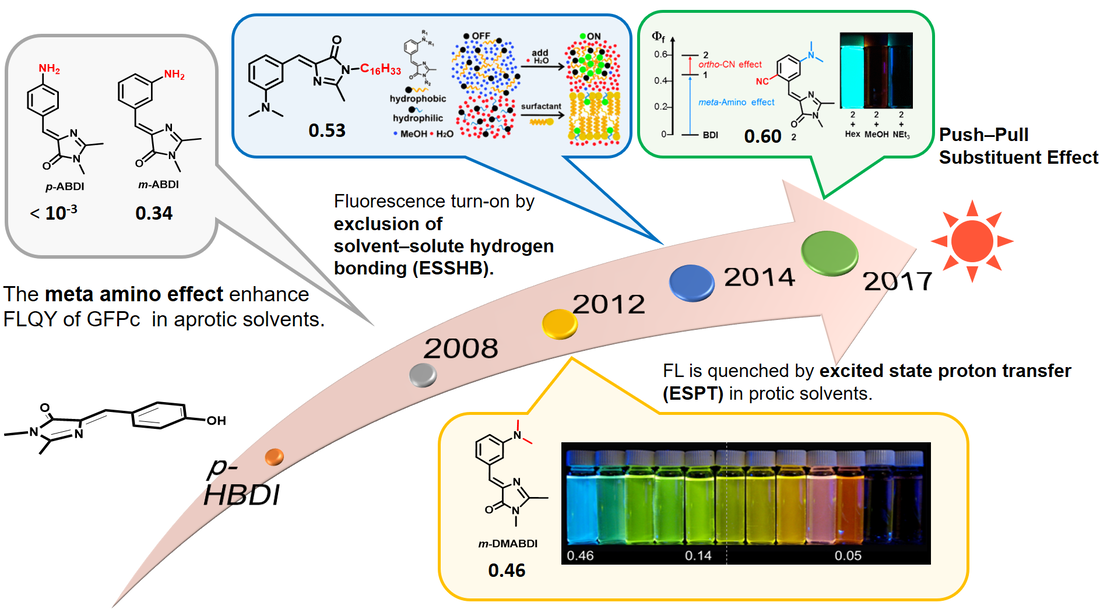
Our lab focuses on the photophysical and photochemical properties of highly fluorescent meta-amino-substituted GFPc. The following figure shows the development history of GFPc derivatives in our lab. We have successfully increased the fluorescence quantum yield from nearly 0 (p-HBDI, wild-type GFPc) to 46% (m-DMABDI). We have explored the GFPc analogues in several aspects, including hydrogen-bonding-induced fluorescence quenching, aggregation-induced fluorescence enhancement, fluorescence quantum yield enhancement, real-time cell imaging, colorful fluorescence patterning, and data encryption and decryption.
The fluorescence quantum yield of GFP is as high as 79%, but the corresponding chromophore (GFPc), p-HBDI, is unexpectedly nonfluorescent with a quantum yield lower than 0.1%. This has prompted chemists to study the excited decay mechanism of p-HBDI and to develop many GFPc-like chromophores. Over the past years, the fluorescence quenching is mainly attributed to the cis-trans isomerization reaction.
Our lab focuses on the photophysical and photochemical properties of highly fluorescent meta-amino-substituted GFPc. The following figure shows the development history of GFPc derivatives in our lab. We have successfully increased the fluorescence quantum yield from nearly 0 (p-HBDI, wild-type GFPc) to 46% (m-DMABDI). We have explored the GFPc analogues in several aspects, including hydrogen-bonding-induced fluorescence quenching, aggregation-induced fluorescence enhancement, fluorescence quantum yield enhancement, real-time cell imaging, colorful fluorescence patterning, and data encryption and decryption.
綠色螢光蛋白 (GFP) 現今廣泛應用於生物標記,其重要性由 2008 年的諾貝爾化學獎三位得主,下村修、馬丁查爾菲、錢永健,分別發現 GFP 以及將之應用於生物研究,對人類研究細胞以及疾病的機制的貢獻可以看出。
由於 GFP 的螢光量子產率高達 79%,而 GFP 中的發光團 (GFPc) 分子p-HBDI 之螢光量子產率卻是出乎意料的低 (< 0.1%),促使化學家研究其原因、並開發出許多GFPc 類似化合物。經過數年的研究後,p-HBDI 的消光主要歸因於順反異構化反應。
本實驗室專注於具有間位胺基取代效應 (meta-amino effect) 之高螢光量子產率的類 GFPc 分子之光物理與光化學性質,下圖為本實驗室的類 GFPc 衍生物開發史。我們由原本不放光的 GFPc (p-HBDI) 成功的將螢光量子產率提升至 46% (m-DMABDI),我們進一步以 m-DMABDI 結構為基礎,研究其氫鍵致使螢光淬滅、聚集致螢光增強、螢光量子產率提升、以及最後成功的將我們的研究擴展到即時細胞顯影、多彩螢光圖、安全墨水的應用。
由於 GFP 的螢光量子產率高達 79%,而 GFP 中的發光團 (GFPc) 分子p-HBDI 之螢光量子產率卻是出乎意料的低 (< 0.1%),促使化學家研究其原因、並開發出許多GFPc 類似化合物。經過數年的研究後,p-HBDI 的消光主要歸因於順反異構化反應。
本實驗室專注於具有間位胺基取代效應 (meta-amino effect) 之高螢光量子產率的類 GFPc 分子之光物理與光化學性質,下圖為本實驗室的類 GFPc 衍生物開發史。我們由原本不放光的 GFPc (p-HBDI) 成功的將螢光量子產率提升至 46% (m-DMABDI),我們進一步以 m-DMABDI 結構為基礎,研究其氫鍵致使螢光淬滅、聚集致螢光增強、螢光量子產率提升、以及最後成功的將我們的研究擴展到即時細胞顯影、多彩螢光圖、安全墨水的應用。
Photoisomerization of the Green Fluorescence Protein Chromophore and the meta-and para-Amino Analogues
Yang, J.-S.; Huang, G.-J.; Liu, Y.-H.; Peng, S.-M.
Chem. Commun. 2008, 0, 1344-1346.
Site-Selective Hydrogen Bonding-Induced Fluorescence Quenching of Highly Solvatofluorochromic GFP-like Chromophores
Huang, G.-J.; Ho, J.-H.; Ch. Prabhakar, Liu, Y.-H.; Peng, S.-M.; Yang, J.-S.
Org. Lett. 2012, 14, 5034-5037.
Aggregation-Induced Emission of GFP-like Chromophores via Exclusion of Solvent-Solute Hydrogen Bonding
Tou, S.-L.; Huang, G.-J.; Chen, P.-C.; Chang, H.-T.; Tsai, J.-Y.; Yang, J.-S.
Chem. Commun. 2014, 50, 620-622.
Fluorescence Enhancement of Unconstrained GFP Chromophore Analogs Based on the Push-Pull Substituent Effect
Tsai, M.-S.; Ou, C.-L.; Tsai, C.-J.; Huang, Y.-C., Cheng, Y.-C.; Sun, S.-S.
J. Org. Chem. 2017, 82, 8031-8039.
Yang, J.-S.; Huang, G.-J.; Liu, Y.-H.; Peng, S.-M.
Chem. Commun. 2008, 0, 1344-1346.
Site-Selective Hydrogen Bonding-Induced Fluorescence Quenching of Highly Solvatofluorochromic GFP-like Chromophores
Huang, G.-J.; Ho, J.-H.; Ch. Prabhakar, Liu, Y.-H.; Peng, S.-M.; Yang, J.-S.
Org. Lett. 2012, 14, 5034-5037.
Aggregation-Induced Emission of GFP-like Chromophores via Exclusion of Solvent-Solute Hydrogen Bonding
Tou, S.-L.; Huang, G.-J.; Chen, P.-C.; Chang, H.-T.; Tsai, J.-Y.; Yang, J.-S.
Chem. Commun. 2014, 50, 620-622.
Fluorescence Enhancement of Unconstrained GFP Chromophore Analogs Based on the Push-Pull Substituent Effect
Tsai, M.-S.; Ou, C.-L.; Tsai, C.-J.; Huang, Y.-C., Cheng, Y.-C.; Sun, S.-S.
J. Org. Chem. 2017, 82, 8031-8039.